The City of the Cheese (Kaasstad)
Downtown Gouda, South Holland province, has, however vaguely, some circular shape, particularly discernible from the air or in old maps, although not as much as that of its famous cheeses, which, in addition to a famous market have their own museum.
Halfway between Utrecht and Rotterdam the city grew upon marshlands which still have large areas to the east, while the west is closed by Gouwe River. There, between the eleventh and twelfth centuries trade took root in the extraction of peat. In early XII they were linked by a channel the currents of Gouwe and the Oude Rijn rivers and in the widening forming in the Hollandsche IJssel was built a port defended by a fortress. Thus the city was placed in the trade routes between France and the Baltic Sea. Now there are some different old boats moored, near the Harbour Museum. In the place once occupied by the castle there is, since 1832, a windmill and, next to it, the old customs house.
Downtown is surrounded by a ring of canals, the Kattensingel, the Bleckersingel, the Fluwelensingel and Turfsingel. And in the middle of the circle is the core of the city and its most notorious buildings. The Stadhuis, city hall, completely isolated amid market square, is one of the oldest Gothic style town halls of the Netherlands, built in 1448, to which the stone master Gregorius Cool added a Renaissance staircase in the beginning of seventeenth century. The particularity of its isolation is due to a fire, when the town hall was built again it was placed there to avoid any future disaster, at least due to fire. On one of the side walls there is a carillon with figures representing the granting of rights to the city by Floris V, Count of Holland, in 1272.
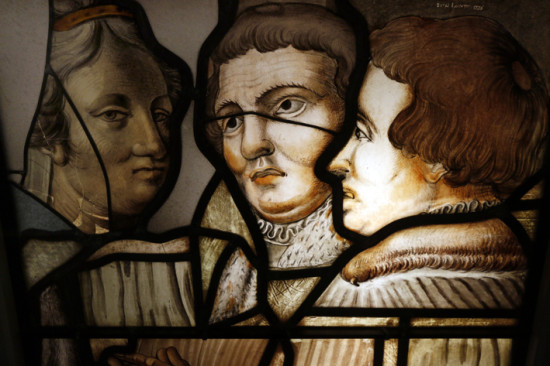
South of the square although visible from this overlook the tower and the roof of John the Baptist church, Sint Janskerk, a long temple whose ship measures 400 feet and is appreciated by its stained glass windows, twenty of which were made by the Crabeth brothers, Wouter Pietersz and Dirk. The reasons why these survived the sixteenth century Beeldenstorm are still unknown. Beeldenstorm literally means the storm of statues and refers to the iconoclastic wave that swept across Europe with Protestantism. In fact, while the Crabeth worked on the windows the church service went from Catholic to Lutheran. The stained-glass windows in question are exceptional for their quality and the accuracy of their making, there are biblical scenes such as the dedication of the temple by King Solomon or the visit of the Queen of Sheba, issues related to the life of Jesus Christ and the Baptist. There are also historical representations such as the capture of Damietta in Egypt by the Crusaders or the conquest of Leiden by William of Orange. The sponsors who financed the works usually appear in the scenes, as Philip II of Spain with his wife Mary Tudor in the stained glass of the Last Supper, or the Duke Erick van Brunswick next to San Lawrence. The organ, made by Jean François Moreau of Rotterdam, is one of the finest instruments of the Dutch Baroque.
Behind the church there is a small park that was once a graveyard. Between the leaves autumn takes to the ground features a pair of bronze statues. One represents a man running a printing press; it is none other than printer Gerard Leeu who published in 1480 Dialogus Creaturarum Optime Moralizatus, a collection of 122 fables of Latin origin inspired by dialogues between animals. Leeu died in Antwerp twelve years later stabbed in a dispute with one of his workers. The second statue corresponds to another of the city's favourite children, one called Geert Geerts who was better known as Desiderius Erasmus or Erasmus of Rotterdam. It was precisely Gouda his birthplace, at least as the fifteenth-century historian Renier Snooy asserts, and also an inscription on a wooden figure where can be read Goudae conceptus, Roterodami natus. In any case the future author of Lof der Zotheid, The Praise of Folly, spent his youth among the streets surrounding Sint Janskerk until he began his religious studies in the city of Deventer.
Near where Erasmus played when children, in the alleys close to the church, was St Katherine Hospital, which currently houses the City Museum. The enclosure gate is a monumental decorated tower that was once on the city outskirts, giving access to the lazaretto, disappeared in 1939. Today, in its new location and under its archway you enter to the pleasant former hospital gardens.
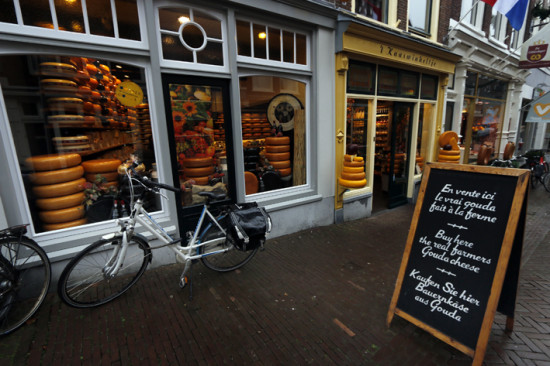
Gouda is primarily known for its cheeses although it was not the only trade, there were also manufactured smoking pipes and had a relevant chandlery and ceramics industries. Behind the town hall in Market Square, there’s the Goudse Waag, the Gouda Cheese Weighing House, a remarkable building by Pieter Post rose in 1668 where the cheese market on Thursday were weighed as shown on the stone slab on the facade, the original, which is inside, was made by Bartholomeus Eggers. The cheese came transported on two wheels barrows, were arranged on the square and, as is still done every Thursday from ten o'clock until one between the months of April to August, buyers and sellers meet and after reaching an agreement ostentatiously shout the accorded price while collide palms, a ritual they call handjeklap.
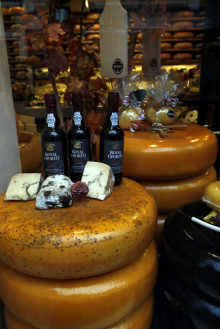
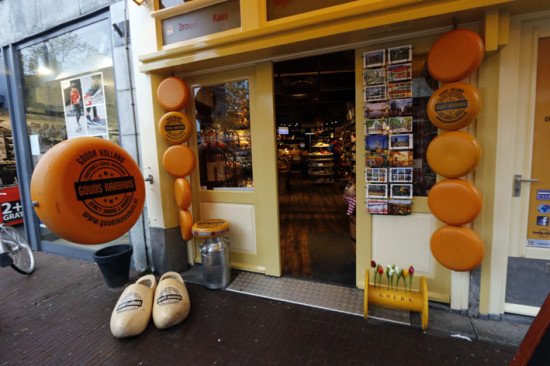
The first written mention about Gouda cheese dates back to 1184 according to the Geschichte des Kases, History of Cheeses by the Centrale Marketing-Gesellschaft der deutschen Agrarwirtschaf, Central Marketing Organization of German Agricultural Industries. The cheese is made with cow's milk produced in the region around the city. In fact the name was adopted for the sale market centralized in Gouda. Curiously the protected designation of origin shows the name of Noord-Hollandse Gouda while the city is located in the southern province. The surface of the cheese is covered with a layer of brine which gives it a peculiar crust and is then dried for a period of time determined by what type of Gouda wished. Cheesemakers distinguish between six different gradations in function of aging time, which start with four weeks for soft cheese to more than five years for the Extra Alte Gouda. Although at present most of the production is industrial there are still about three hundred farms producing handmade Boerenkaas, farmer cheese using unpasteurized milk. In the Netherlands are often served as an appetizer cheese snacks accompanied by mustard or apple syrup. For the aged varieties pairing improves with corpulent beers or Porto wines.
The Goudse Waag, the old building of the weighing, currently houses the Museum of Cheese where in addition to the history related to its production are exhibited weighing tools used in the building and, of course, you can taste and buy the famous Gouda cheese.
© J.L.Nicolas