Menorca, flashing portrait
In the memory the island is a syncopated succession of recalls, many of them monochromes, some in colour, some have reappeared after a long time hidden among negative archives and other, newer, have been wilfully created again in black and white.
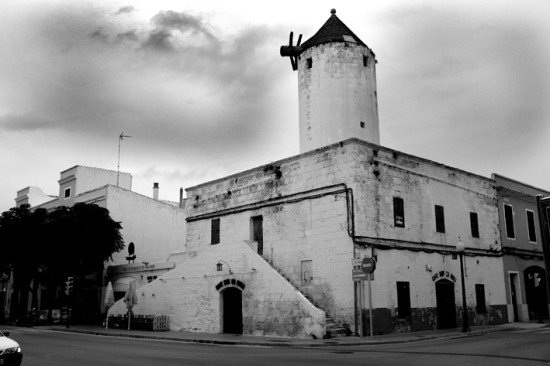
Ferries from Barcelona and Valencia used to dock in the sheltered harbour of Mahon early in the morning, after sailing overnight and defraying the northern coast of the island with the first light of dawn. Anyway it will always be a tinted memory of the warm dawn light. Beyond Lazaretto and King Island over the city skyline are profiled the churches of Santa Maria and Sant Francesc. The heavy slip of the ship on the water dragged into the past the contours of the first houses that were seen on the docks, the first barge floating in the estuary. Everything was left behind as the march slowed down and maritime station get closer. After mooring manoeuvres and landing, the seemingly endless staircase that shortens the road to the city through the Costa de ses Voltes appears. Mahon was often a scale, a process to resolve on the road to Ciutadella. So it was little more than crossing beside City Hall and then under the Portal of San Roc heading Ciutadella Street and once on the road find a generous soul to shorten the journey to the other end of the island. Surely it is for that reason, for being a place of passage, which, over time, Mahon has become aseptic, a neutral phase, discharged from any memory except those that form of writing, the views over Sant Francesc from the hotel room window filtered through the thin veil of the curtain and, after, get the snapshots that catches the eye: the label of the American Bar, some browsed books on a bookstore counter, Costa des General, the passageway who they say is one of the few reminiscences of Moorish architecture on the island, reflections of the sun against the boinders, as they call the bow windows, Isabel II Street, once before named Sant Cristòfol or Monastery, the confusing Venice across the estuary, which it is nothing else than a house that juts out into the waters and has been recovered as an exhibition space.
Resolved the process of transport, the road advances through the inner of the island as the core of a spine, parallel to the old road governor Kane opened during the years of the British Minorca. It is a flat route where the highlights are the continuous dry stone walls parcelling everywhere the island. The first slope on the horizon is the town of Alaior whose Santa Eulalia church crowns the mound around where the urban grid is woven. The following reference is impossible not to lose. Next sight on the road is Es Cap de s'Indi, the rock shaped as an Indian chief head, with his aquiline profile, announcing the proximity of Mercadal.
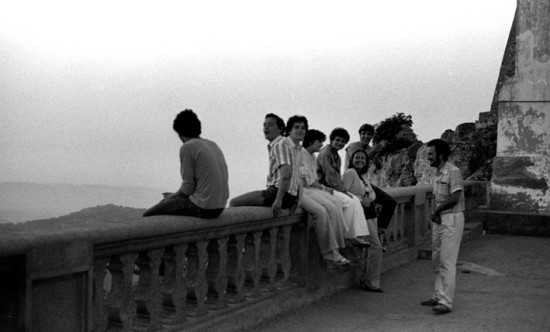
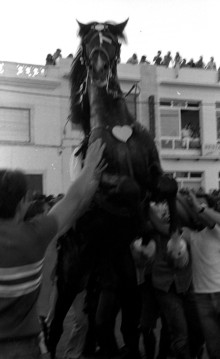
Mercadal got its name for the privilege granted by James II allowing celebrate market every Thursday. But besides the market, the town held during the third weekend in August Sant Martín celebrations, for the Renaissance church that stands over the skyline. As elsewhere on the island the feasts, inconceivable without horses plays where people helps to lift up the animals with their horsemen, succeed in a few days seemingly endless despite gin. That so particular manufactured in Mahon - an English heritage - which is so easy to handle thanks to the hoop by the bottle neck. August is a month lavish in festivals and in those days of 1979 it would not be less. To Mercadal feasts followed, a week later, those of Fornells, in the northern tip of the island. Fornells languishes in winter time in the shore of a sheltered harbour with calm waters. It is not the same in summer. There, besides the usual horse games and gin seemed to be fancy jump into the harbour waters completely dressed before began to sound the first notes of the orchestra and enjoy dancing. Sometimes, the feast paused at the top of Mount Toro to watch the sunrise. Mount Toro is with its 1122 feet, the highest point of the island. There is the sanctuary of the brown virgin, Mare de Deu del Toro, patroness of the island. They say the figure was found thanks to the signs a bull made to a friar. What is certain is that the view from the railing is outstanding, even without having slept. With the first fogs Fornells Bay is clearly seen and to the left is Cavalry Point. Of course also it’s perfectly seen Mercadal town and beyond the top of Santa Agata. The sanctuary of Toro is the object of pilgrimage, in my case just to the viewpoint railings where I come back several times along the years, perhaps to see the same faces than in 1979, however, as expected, only there was the landscape and the empty railing, even if it was loaded with distant echoes.
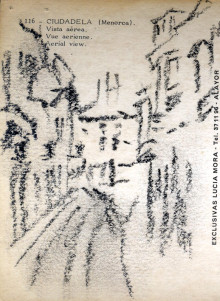
At the end of the road appear Ciutadella’s first houses. In the summer of 1978 we continued even farther beyond, to the sea and up to pitch our tents in a vacant place next to Sa Platja Gran along with other adolescents provided with limited funds. In addition to the tents the place was occupied by the rickety remains of an abandoned car. When we allowed a luxury we were going to eat egg and chips at a nearby bar although most of the money ended up in the box of the neighbouring nightclub, the then famous and now disappeared Mannix.
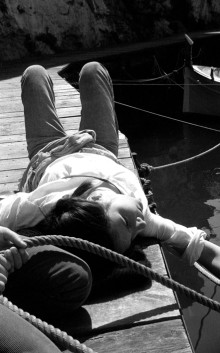
Half a year later, in 1979 Eastern, I repeated the road journey from Mao to Ciutadella, this time with two female friends. They enjoy the sun and used to lay back on the port wooden walkway, those same I photographed on other occasions, perhaps hoping to find them appear right there... which amazingly happened thirty years later.
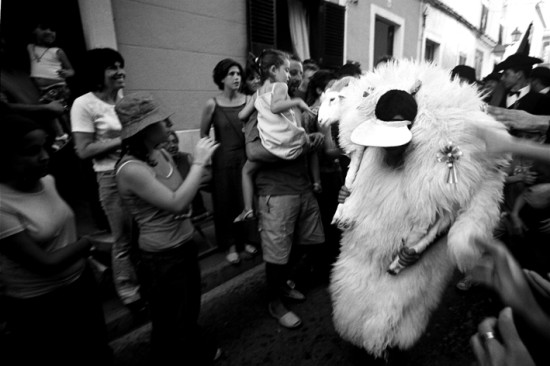
Ciutadella, despite being the island largest population is a quiet medium sized town, almost deserted in winter, but that is altered with the arrival of tourism and completely berserk during Saint John festival. This starts on the Sunday before the saint’s day, here called Diumenge es Bé, the Lamb Sunday: At nine o'clock starts the procession that will inform the population about the beginning of the celebrations. A character dressed with a sheepskin jacket accompanies the cortege carrying a live lamb on his shoulders. On Saint John eve, on the first day of the equestrian shows, a delegation will horse to Sant Joan de Missa hermitage and back. Then they start a horse ride through some of the streets where many houses have prepared the entrance to ease the access to the horses and greet the riders. On next day, Saint John’s, hatch the festivities.
I returned often, using to stay at a good friend’s home. He liked to cook and over the years we exchanged photographs of the dishes we prepared with the sole intention to provoke envy, without ever missing a glass of gin with which garnish not the dish but the chef. There, in Ciutadella, we used to garnish ourselves at lovely places such as the Arco, Cas Marino or the Rooster Home, before going through the market to buy the fish needed to prepare a good rice dish.
I have not stopped to come back to Menorca, to recall and to create new memories for the future. Perhaps the only difference is that I tried to harmonize them, now again in black and white, as in the early days.
© J.L.Nicolas