Sagunto Urban Shrines
Sagunto has several baroque hermitages, curiously, most of them located in the city historic centre. Since 2012 they have recovered the polychromy of striking framed facades in the heart of the urban area.
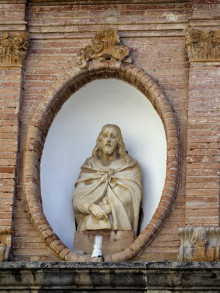
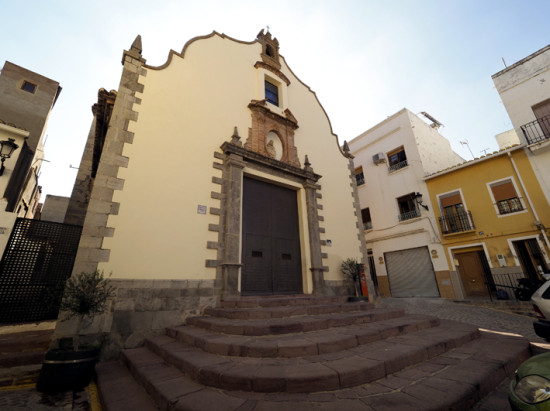
The best known and the largest one is the Shrine of the Blood, located in a bend of Sang Nova Street. It dates back early seventeenth century, when was founded in the year 1607 the Brotherhood of the Immaculate Blood of Our Lord Jesus Christ, the Brotherhood of the Sang, summarizing. It is the oldest baroque temple in Camp de Morvedre region since it was built formerly in the place that had occupied the Jewry synagogue, until it was moved to its current location. A semi-circular staircase with seven steps leads to the entrance, closed by a double door decorated with golden panels. Above it, in a niche, there is a bust image of Christ, covered with a cloak and with his hands gathered, grasped. The cornice of the facade has curvatures in opposite directions, finished at the ends by stone needles and topped by a small steeple belfry crowned with a metallic cross. The interior of the hermitage has a Latin cross plan, with just one aisle covered by a vault and a cupola on the cruise. Inside, frescoes with scenes of the Passion cover the dome inside.
In the same block, but in the opposite, at number 22 Dolors Street, is the simple Ermita de los Dolores, next to two white houses that seem to continue the surface of the facade. The semi-circular arch door is on two steps that occupy the narrow width of the sidewalk, practically non-existent. On each side of the door two tiles refer to the name of the oratory, a third ceramic warns about the number on the street, and on these there is an altarpiece, also made of ceramics, with the Dolorosa and Christ, already deceased, in her arms. A frieze separates the steeple topped by a weathervane. At the door, an oval peephole reveals the altarpiece with an image of the Dolorosa, the Sorrowful.
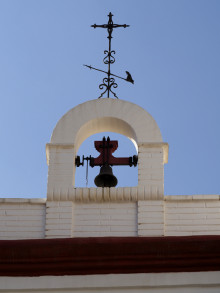
In the square that forms the separation of the streets Castell and Antigones, the Ermita de la Magdalena, just stands out in a corner, next to the arch that marks one of the old gates of the Jewish quarter. Its whitewashed façade and rectangular door would not attract attention except for the brief semicircular belfry topped by a wrought iron cross, holding a small bell. Several tiles indicate the name, number and an image of the Magdalena. The inside is tiny, about nine feet deep by a six of width, where, next to the altar, there is a figure of St Blaise in a dark niche, near another one of the Magdalene.
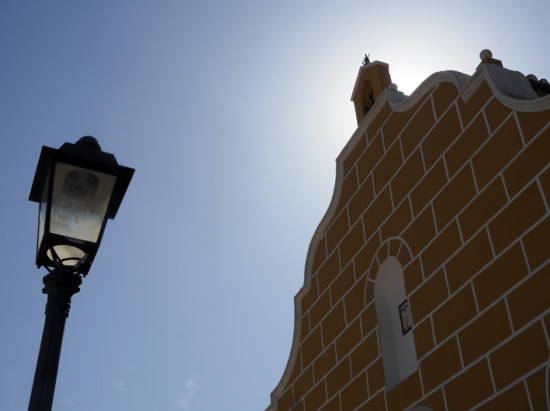
On the way to the castle and at the end of the Via Crucis that ascends towards the hill, stands the colourful Ermita de la Soledad en el Calvario, the Hermitage of the Calvary Solitude. Calvary path was built in the nineteenth century and it climbs seven sections in a zigzag walkway. It has, on the top, good views of the city. The last three stations are shown on the façade, on both sides and above the door, to which four broad steps lead. The facade is painted in a bright ochre colour, between yellow and orange, simulating the shape of stone blocks. It ends in a baroque cornice and a small belfry, which seems shrunken. Two chapels, one on each side of the aisle, enlarge the square floor plan structure. Some small rectangular windows try to illuminate the inside. The hermitage appears on some canvases by the painter Santiago Rusiñol.
In St Anne neighbourhood, at the intersection of Bon Succes and Santa Anna streets, it closes a narrowing corner the Ermita del Buen Suceso, an almost tiny temple, since the beginning of the 19th century, covered by a dome of tiles over the two waters roof. The facade was divided into two sections, the lower barely contains the door, rectangular and without any concession to any ornamentation, simply the number 10 and the tiles with the name. Above the lintel, the rest of the tiled facade surrounded the bulrush, until it was painted ochre colour with garnet profiles homogenizing the whole. Under the hole that houses the bell there is a 1951 ceramic with the image of the Virgin, Our Lady of Good Success. They say that the image kept on the altar arrived at Sagunto by sea, in a mysterious bulge that, floating, did not allow any boat to approach it to gather it, until a priest managed to rescue it from the waters. Once on board it was found that it was an image of the Virgin carved in heavy marble.
Ermita de San Miguel, from the 18th century, is located at the intersection of the homonymous street and the Main Street. A dome of tiles covers the oratory that seems almost semicircular because of the apse is so close to the doorway, in fact it has an oval plant with two sacristies added in the 18th century. With few ornamental concessions, has a stone lintel with an inscription carved: “Desta puerta los umbrales no puede pasar Luzbel porque dentro está Miguel.1746”. ("Through these thresholds Luzbel cannot cross because inside is Michel.1746"). Next to the lintel there are two lamps and above a ceramic in a circular niche where the archangel is depicted steeping upon the devil, next to it two tiles recall the name of the hermitage and the 250th anniversary of its construction. Like others, a belfry above the eaves tops it. On the eastern facade, stands out the Sundial with the hard to understand inscription: “Lo hizo un deuto Ano 1794 hoelcurios qe lo míxe una cosa sele encarga q no oblie mis hierros y dysimulemistallas”.
In the Main Street, almost touching En Font Street, Ermita de San Roque or Desamparados stands in a corner on a slight widening, shortly before reaching the Main Square. The neighbours in gratitude for the end of the plague raised it in 1647. The whitewashed facade is sober, just a window not too wide above the door and a belfry, the largest of all hermitages, with three eyes on two levels, located in the middle of the roof. The hermitage was dedicated to St Roch until 1797, when the cult of Our Lady of the Forsaken was also incorporated.
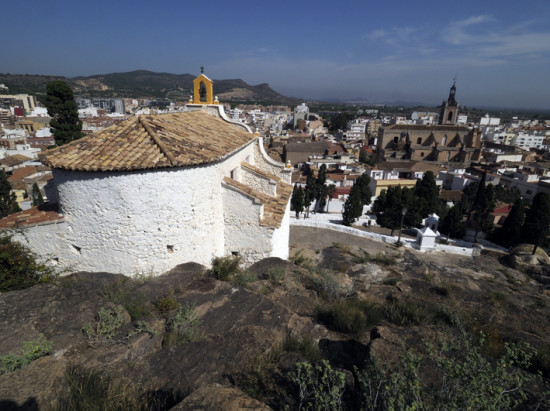
Outside the urban area, on the outskirts of the city, Sagunto has two more hermitages, that of San Cristobal and that of the Virgin of the Miraculous Medal. The first is on the namesake hill, 250 feet above sea level, dating from the late thirteenth century and rebuilt in the 60s. The second is higher, at 1.200 feet, on Mount Picayo. It has a curious facade painted white and outlined with a deep dark blue, with two semicircular chapels protruding outwards, in the middle, the belfry hollow does not house a bell, as would be expected, but an image of the Virgin.
© J.L.Nicolas
See more pictures